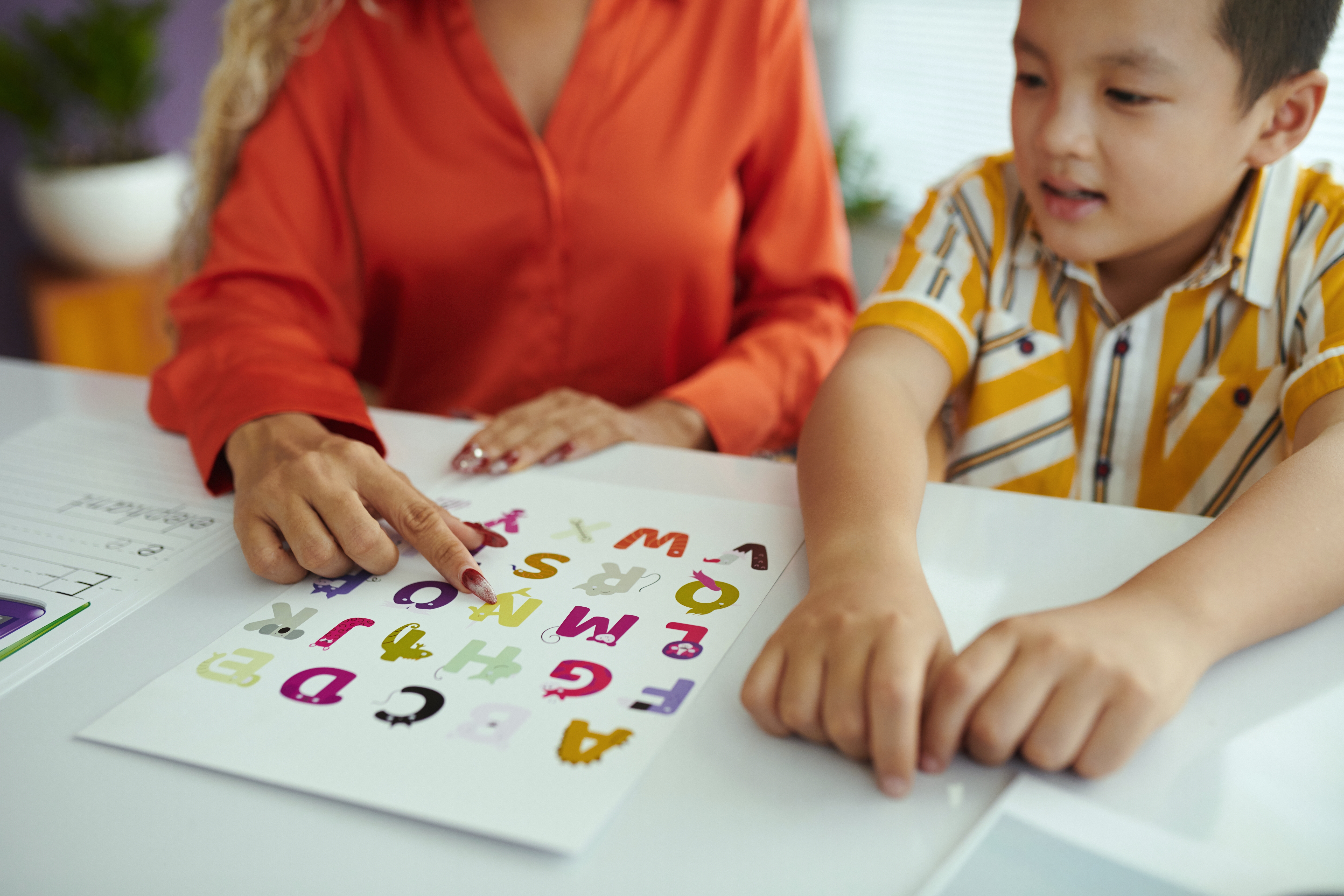
The term “nonverbal” describes children who rely on methods other than spoken words to communicate, and can include those who do not communicate at all. It’s important to remember that “nonverbal” is not a fixed label; with treatment and support, many children develop communication skills over time.
Professionals might also use these terms, which have slightly different meanings and will change the approach of therapy:
Preverbal: This applies to a child who doesn’t talk yet but shows early signs of learning how to communicate by gesturing and making specific sounds.
Minimally verbal: This applies to a child who may use a few words or phrases incoherently or with little meaning.
Nonspeaking: This term is used for children who do not use spoken words. (It is often preferred over the term “nonverbal” as it acknowledges that they may use forms of communication other than speech.)
The Spectrum of Communication in Autism
Speech is far from the only form of communication for children with autism. There are various others that are attainable for nonverbal children and all will help to decrease frustration and angst for both you and your child.
Some children will use gestures, others use sound or specific behaviors. Sign language or an Augmentative and Alternative Communication (AAC) device is also an option for many children. The goal of ABA therapy is to take the communication signal your child is most comfortable with—whatever it may be—and make it clearer and more effective.
Why Some Children With Autism Don’t Speak
Children with autism can struggle with communication more than others because of a few factors.
Difficulty coordinating speech movements
Speech requires movement, and if your child struggles with the coordination needed for those movements, it could make speaking difficult for them.
Different language processing
Their brain can also process and produce language in different ways, which can create gaps in what your child can receive and express. This can also be why many nonverbal children understand more than they can express.
Sensory differences
Differences in how your child processes sensory input can also cause them to struggle with interpreting sound.
All of these are simply neurological differences and not a reflection of a child’s intelligence or potential.
How ABA Therapy Helps Nonverbal Children Communicate
ABA therapy begins by assessing your child’s current communication skills. The therapy team then works to figure out what message your child is trying to express through their behavior, such as a meltdown or a specific action. A plan is then created to build functional alternatives—new, effective ways for your child to communicate their needs.
The focus of ABA is not to force speech, but rather to build pathways to communication—helping your child reach a level of functional communication using the method that works best for them.
Here are some of the specific methods ABA therapy uses to build those communication pathways:
Functional Communication Training (FCT)
This is a commonly-used methodology in ABA therapy for nonverbal children. FCT teaches children effective ways of requesting, refusing, and expressing needs through whatever modality works best for them—instead of resorting to frustration-driven behavior.
For example, if someone has the radio playing too loudly in the house, your child can learn to say ‘stop,’ press a button, or tap the culprit on their elbow to ask them to turn it down, instead of yelling or throwing dishes to the floor.
A shift like this can lead to a significant decrease in daily frustration for both you and your child.
Picture Exchange Communication System (PECS)
PECS is a highly effective method, particularly for visual children. It teaches children to show a picture that communicates their want or need. For example, a child might hand you a picture of an apple to request a snack.
ABA therapy will build this up over time, starting with single pictures and building up to picture combinations and whole sentences.
Augmentative and Alternative Communication (AAC)
Augmentative and alternative communication (AAC) refers to any devices that assist communication, from high-tech speech-generating devices or low-tech picture boards.
Using an AAC device does not make nonverbal children with autism likely to give up on learning to speak on their own. On the contrary, research shows they can actually support verbal development. With a reliable communication method, a child’s frustrations will decrease, so their conditions for learning improve.
You don’t need to view an AAC device as a last resort; your child can use it alongside nonverbal autism therapy to support their speech and communication skills in ABA therapy.
Discrete Trial Training (DTT) and Natural Environment Teaching (NET)
DTT is when a skill a child needs to learn is broken down into very small steps and applied repeatedly with positive reinforcement. In nonverbal autism therapy, this can be something like picking up a red card to show a dislike for a food item.
Once your child is comfortable with the new action, Natural Environment Teaching (NET) can be used. NET takes the communication skill learned in the controlled environment and brings it into real-life settings like the dinner table or sandbox. Practicing the skill in natural situations helps your child spontaneously use that skill when needed. For example, NET helps your child learn to use the red card at the dinner table to communicate ‘No thank you’ when presented with a disliked food.
What Progress Looks Like for Nonverbal Children in ABA
When supporting your nonverbal child through ABA, it’s helpful to remember that progress often comes in small, non-linear steps.
This might look like:
Your child independently handing you a PECS picture to request their favorite snack.
Your child speaking their first word after months of dedicated therapy.
A reduction in meltdowns because your child now has a way to communicate “stop” or “I need a break.”
Each one of these milestones, no matter how small, indicates your child is progressing in communication—and that’s something to be celebrated.
Early Intervention and Long-Term Outcomes
Many parents wonder about the “right” time to start. Research strongly suggests that intensive early ABA therapy—especially when started before age 5—is often correlated with greater communication gains for children with autism. However, it is crucial to remember that every child’s journey is unique. While early intervention is powerful, progress is individual, and it’s important for families to avoid setting rigid timelines or expectations.
Measuring Growth Beyond Words
Families and clinics will measure more than speech to assess a child’s progress. The success of ABA therapy for nonverbal children with autism can be tracked in many ways.
Some meaningful progress markers are when a child communicates more frequently in any method, when they show less challenging behavior than they used to, or when there’s an increase in their social engagement and independence.
How You Can Support Your Nonverbal Child at Home
Here are some practical strategies you can apply at home to reinforce your child’s progress outside of ABA therapy:
Follow Your Child’s Lead
Try to notice what interests and excites your child. When you are aware of their interests, you can use them as conversation starters. Your child will be motivated to communicate if the topic is meaningful to them.
Reinforce Communication Attempts
Make sure to respond to and reward any attempt at communication your child offers—not only speech. Respond to all gestures, sounds, moments of eye contact and offer positive reinforcement.
Create Communication-Rich Environments
You can help your child by using visual supports at home, keeping their routines consistent and predictable, and narrating daily activities. All these help to build momentum for communication.
How United Care ABA Supports Nonverbal Children and Families
At United Care ABA, our Board Certified Behavior Analysts (BCBAs) begin every program with an assessment of your child, taking into consideration their current communication skills, learning profile, and family priorities.
We set meaningful goals that fit with those considerations, and which truly help your child according to their needs. We see parents as the partners they are in helping their child, and we offer parent coaching as part of our programs, so the skills your child learns can be reinforced and developed in real life.
We accept most insurance plans, and our team can help you find out if your insurance will cover ABA therapy. If you’re ready to begin intervention for your child, please reach out to explore your options. We’ll help you find a path that fits your child, yourself and your family.