
Noah wants the truck that Maya is playing with, and you can already feel the tornado that’s about to rip through the living room. Grabbing, shrieking, someone in tears – plus a twenty-minute wind-down that leaves everyone exhausted.
You brace yourself –
And then Noah stops.
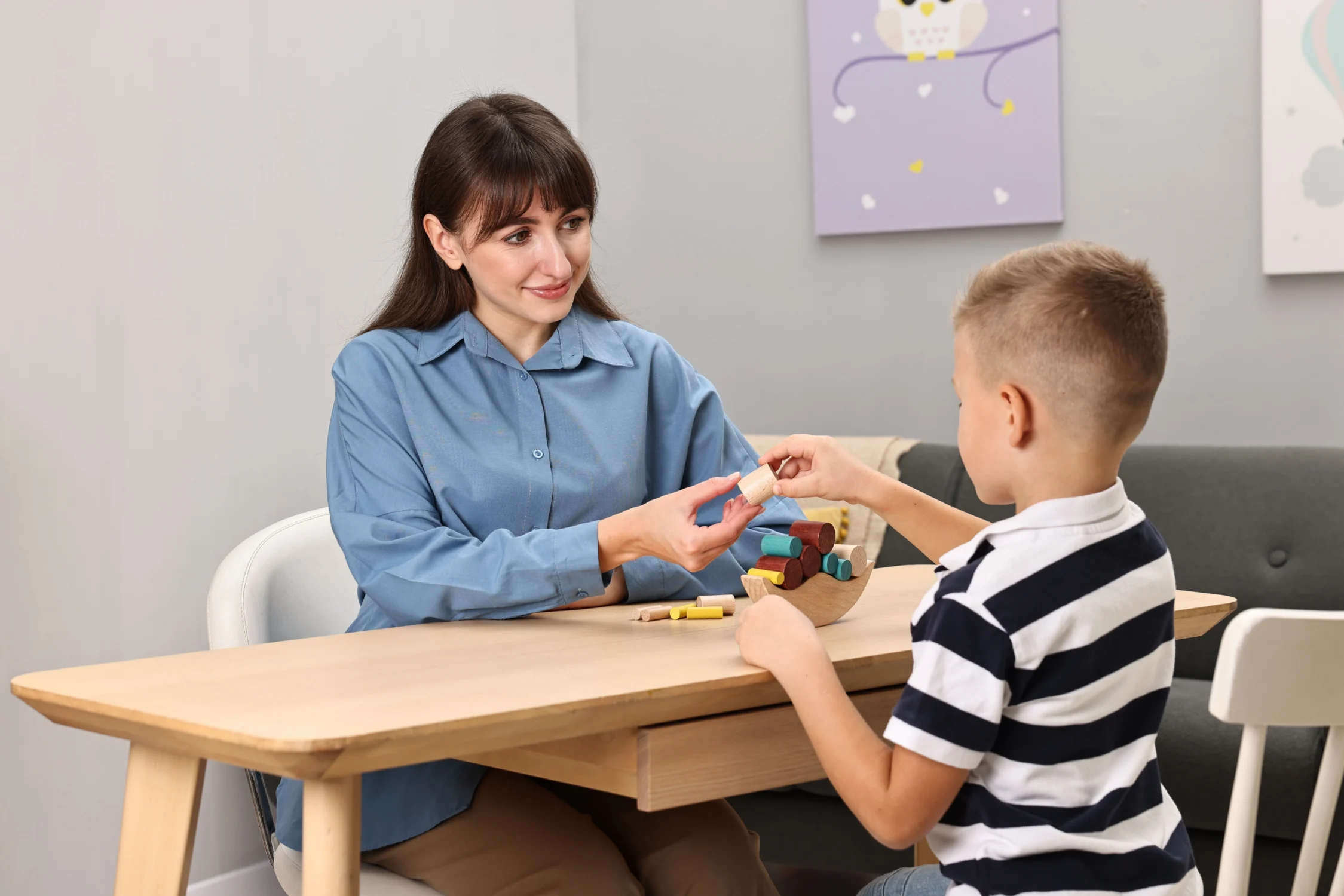
He picks up the picture card from the table – the one with the truck – and holds it out instead.
Noah still struggles. Mornings are still hard, stores are still too loud. But somewhere in his ABA treatment plan, there was a goal about asking instead of escalating. And on this ordinary Tuesday, he met it.
That’s how ABA works.
Every session runs on specific, measurable goals – tailored to the child and building toward something bigger.
Such treatment plans can look clinical on paper. This is what they actually mean.
What Is the Goal of ABA Therapy?
The goal of ABA is simple: to give the child more skills and independence, while reducing behaviors that get in the way of daily life.
Common ABA Therapy Goal Areas
ABA goals fall into common categories, but your child’s goals will always be specific to them.
Communication and Language
- Requesting items or activities
- Responding to questions
- Following directions
- Expanding vocabulary
Sample goal: requesting an item by holding up a picture card instead of screaming.
Social Skills
- Turn-taking
- Initiating play
- Reading social cues
- Sharing
Sample goal: walking up to a classmate at recess and saying their name.
Self-Care and Daily Living
- Toileting
- Dressing
- Brushing teeth
- Handwashing
- Mealtimes
Sample goal: getting through the whole handwashing routine with only one reminder.
Behavior Reduction and Replacement
- Reducing aggression, self-injury, wandering, or tantrums
- Replacing them with functional alternatives
Sample goal: asking for help instead of throwing objects when frustrated.
Play and Leisure
- Engaging with toys functionally
- Taking turns in games
- Developing imaginative play
Sample goal: sitting down with a puzzle and completing it.
Academic Readiness
- Attention to task
- Following multi-step instructions
- Matching
- Sorting
- Early literacy and numeracy foundations
Sample goal: staying at the table long enough to finish an activity.
How ABA Therapy Goals Are Set
Initial Assessment by a BCBA
Before anyone writes a single goal, a BCBA spends time getting to know your child – their skills, their behaviors, their history, where things are hard and where they’re not. That assessment is the foundation everything is built on.
Parent and Caregiver Input
The BCBA brings clinical expertise. You bring something they can’t get anywhere else: what actually matters for your child’s daily life.
What would make mornings easier? What does your family need?
Goal-setting in ABA is collaborative. The plan isn’t handed to you, but built with you.
SMART Goal Framework
An ABA goal is SMART: Specific, Measurable, Achievable, Relevant, and Time-bound. In practice, that turns vague goals like “improve communication” into something like: Dana will independently request three items using a picture exchange system 4 out of 5 times by June.
When a goal is that specific and defined, you never have to guess if it’s being met.
ABA Therapy Goal Examples Parents Can Recognize
Social Skills
- Clinical goal: Nick will share toys with peers during group activities at least 4 times per session, 3 sessions in a row.
- What you’ll see: Nick hands Cindy the shovel he was using and takes the rake instead.
Self-Care
- Clinical goal: Josie will independently complete her handwashing routine with one verbal prompt before starting kindergarten.
- What you’ll see: You say “wash your hands” once, and she does.
Behavior Replacement
- Clinical goal: Priya will remain within designated boundaries during community outings in 4 out of 5 opportunities by June.
- What you’ll see: At the grocery, Priya stays next to the cart instead of wandering away.
How Goals Are Tracked and Updated
Data Collection and Progress Monitoring
Every session, the therapist tracks the data – specific, measurable observations tied to each goal – so you can see actual progress in the charts.
Regular Treatment Plan Reviews
Every six months or so (typically aligned with insurance authorization cycles) the BCBA reviews the plan and updates it accordingly – replacing mastered goals, adjusting ones that aren’t moving. The plan is supposed to fit your child, so if it doesn’t, it changes.
When Goals Change
ABA has a natural arc: foundational goals give way to more complex ones as a child develops.
Nick learns to say hi to a peer. Next he works on keeping a conversation going.
Priya learns to stay close in the grocery store. Next she works on navigating a school hallway.
Each goal is a stepping stone to greater levels of independence.
Your Role in Your Child’s ABA Goals
Your involvement in your child’s goals doesn’t just support their progress – it accelerates it.
During parent coaching, your child’s BCBA will walk you through the strategies they’re using and share how you can apply them in your child’s everyday moments.
Because it’s what you do between sessions that turns a goal into a lasting skill.
How United Care ABA Approaches Goal Setting
Kayla isn’t Danny isn’t Jorge. That’s why every treatment plan at United Care ABA is built from scratch around each child. Plans are BCBA-led and data-driven, and they evolve with your child.
FAQs About ABA Therapy Goals
What is the main goal of ABA therapy?
The main goal of ABA Therapy is to build meaningful skills and independence while reducing behaviors that get in the way of daily life.
How are ABA therapy goals decided?
A BCBA starts with a comprehensive assessment of your child, then works with your family to identify priorities. What matters most in your child’s day-to-day shapes their custom plan.
Can parents help set ABA therapy goals?
Absolutely. You know your child’s daily life best, so your input is an integral part of the goal-setting process.
How often are ABA goals updated?
Typically every six months. Mastered goals get replaced with new ones, and goals that are languishing get adjusted.
What happens when a goal is mastered?
The goal gets retired and a new one – usually something that builds on the skill your child just mastered – takes its place.