
If your child is in ABA therapy, you’ve probably watched a therapist guide them through a new skill—maybe learning to wash their hands, say a new word, or follow a direction. And you might have noticed that the therapist doesn’t just tell your child what to do. They use cues, gestures, or gentle guidance to help your child succeed.
That’s prompting. And the way those prompts are chosen and used follows something called a prompting hierarchy.
Understanding the prompting hierarchy can help you see what’s happening during therapy sessions and how you can support your child’s learning at home. It’s a tool that helps children build independence by starting with the least amount of help they need and gradually fading support as they get better at a skill.
Let’s break down what the prompting hierarchy is, how it works, and why it matters for your child’s progress.
What Is the Prompting Hierarchy in ABA?
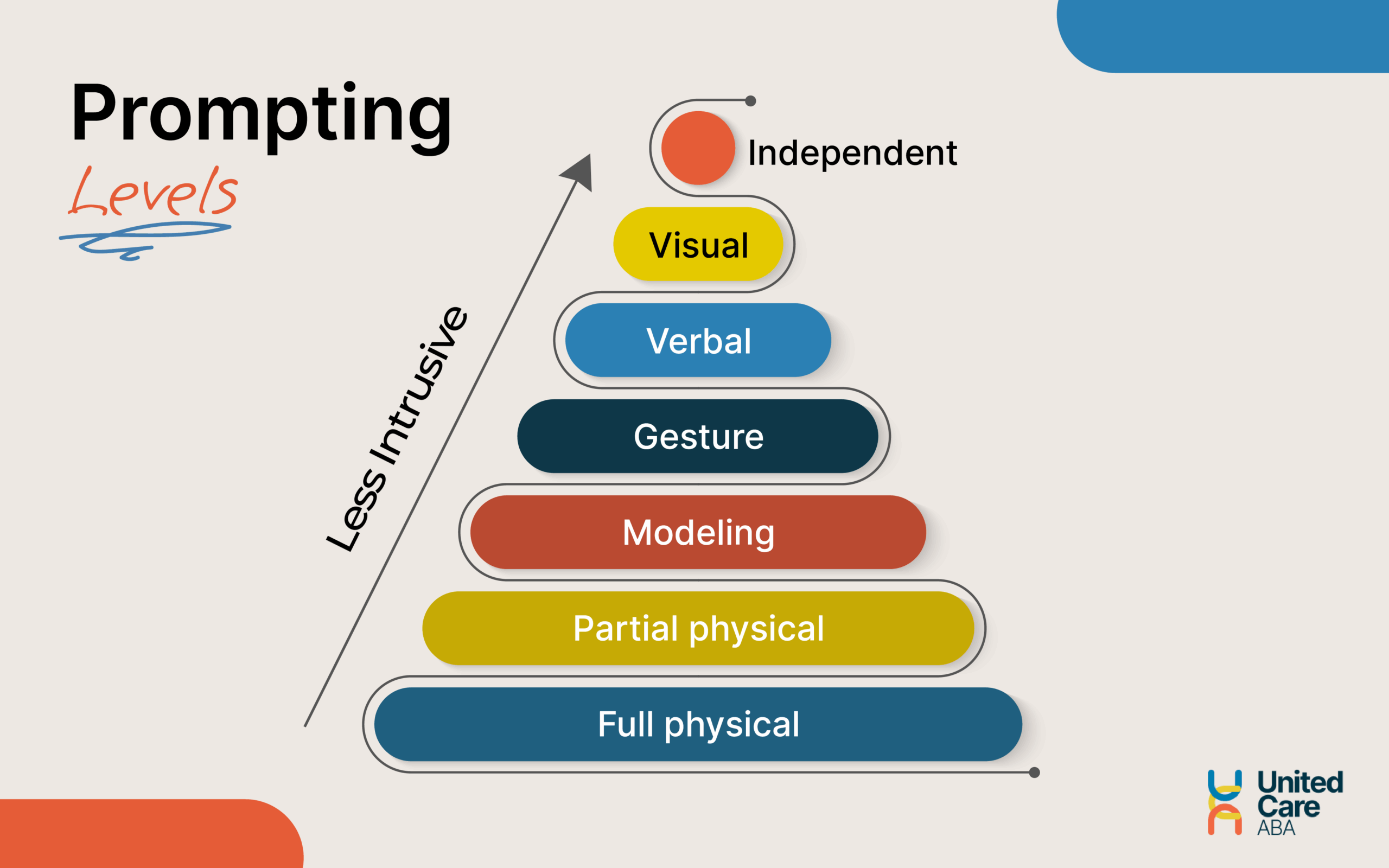
The prompting hierarchy is a framework that therapists use to teach new skills. It organizes different types of prompts—from the least intrusive to the most intrusive—so therapists can give just enough help for a child to succeed without giving more help than necessary.
The goal is independence. When a child is learning a new skill, they might need a lot of support at first. But over time, the therapist fades those prompts so the child can do the skill on their own.
Think of it like teaching a child to ride a bike. At first, you might hold the back of the seat and run alongside them. Then maybe you just touch the seat lightly. Eventually, you let go completely. The prompting hierarchy works the same way—it’s a gradual release of support.
There are two main approaches to using the prompting hierarchy: least-to-most prompting and most-to-least prompting. We’ll get into those in more detail shortly, but the basic idea is that therapists choose how much support to start with based on what the child needs and what skill they’re learning.
The Different Types of Prompts
Prompts exist on a continuum. Some are very subtle. Others are more direct. Here’s a breakdown of the most common types of prompts, organized from least intrusive to most intrusive:
Natural Prompts (Environmental Cues)
These aren’t added by a therapist or parent—they’re already part of the environment. A natural prompt might be the sound of a timer going off, which signals that it’s time to transition to another activity. Or it might be seeing a coat by the door, which reminds your child to put it on before going outside.
Natural prompts are ideal because they’re part of real life. The more a child can respond to natural cues, the more independent they become.
Gestural Prompts
A gestural prompt is a physical cue like pointing, nodding, or motioning toward something. For example, if you’re teaching your child to put their cup in the sink, you might point toward the sink instead of saying anything.
Gestural prompts are subtle and give the child a chance to figure out what to do with just a small hint.
Verbal Prompts
Verbal prompts are spoken cues. They can range from indirect hints to direct instructions.
An indirect verbal prompt might be, “What do we do after we finish eating?” A direct verbal prompt would be, “Put your plate in the sink.”
Verbal prompts are common, but they can also become a crutch if they’re not faded. The goal is for the child to eventually do the skill without needing to be told.
Modeling Prompts
Modeling means showing the child what to do. You demonstrate the action, and the child imitates it.
For example, if you’re teaching your child to wave goodbye, you might wave first and wait for them to copy you. Modeling works well for skills that involve motor movements or sequences.
Partial Physical Prompts
A partial physical prompt is light physical guidance. You might gently touch your child’s elbow to guide their hand toward a toy, or lightly tap their shoulder to remind them to sit down.
Partial physical prompts give just enough assistance to help the child complete the action without doing it for them.
Full Physical Prompts
Full physical prompts involve hand-over-hand guidance. You physically help the child complete the entire action.
For example, if you’re teaching your child to brush their teeth, you might place your hand over theirs and guide the toothbrush through the motions. This is the most intrusive type of prompt, but it’s sometimes necessary when a child is learning a brand new skill or when safety is a concern.
Two Ways to Use Prompts: Least-to-Most vs. Most-to-Least
The prompting hierarchy can be used in two different ways, depending on what the child needs.
Least-to-Most Prompting
In least-to-most prompting, you start with the least intrusive prompt and only move to a more intrusive one if the child doesn’t respond.
For example, let’s say you’re teaching your child to hang up their backpack when they get home. You might start with a natural prompt—the hook on the wall. If that’s not enough, you add a gestural prompt by pointing to the hook. If they still don’t respond, you move to a verbal prompt: “Where does your backpack go?” If needed, you escalate to modeling or physical guidance.
Least-to-most prompting is great for skills the child is starting to learn but still needs some support with. It encourages independence by giving the child a chance to succeed with minimal help.
Most-to-Least Prompting
In most-to-least prompting, you start with a more intrusive prompt and gradually fade it over time.
For example, if you’re teaching your child to cross the street safely, you might start with full physical guidance—holding their hand and walking them across. Once they understand the routine, you might switch to a verbal prompt: “Look both ways.” Eventually, you fade to a gestural prompt (pointing to the street), and finally, the child crosses independently.
Most-to-least prompting is often used when teaching new or safety-critical skills. It ensures the child succeeds from the start, which builds confidence and reduces frustration.
Why the Prompting Hierarchy Matters for Your Child
The prompting hierarchy isn’t just a teaching tool—it’s a way to build real, lasting independence.
It Helps Your Child Gain Independence
The whole point of prompting is to eventually fade it. When therapists use the hierarchy strategically, they’re constantly working toward the child doing the skill on their own. That’s progress.
It Prevents Prompt Dependence
Prompt dependence happens when a child becomes so used to receiving prompts that they wait for them instead of trying on their own. For example, if a child always hears “Say thank you” before they say it, they might stop saying it unless they’re prompted.
The prompting hierarchy helps avoid this by teaching therapists and parents to fade prompts as soon as possible.
It Encourages Natural Learning Opportunities
When prompts are used thoughtfully, children start responding to the natural cues in their environment instead of waiting for someone to tell them what to do. That’s how skills generalize to real life.
It Allows for Measurable Progress
Therapists track which prompts a child needs and when. Over time, you’ll see the level of prompting decrease, which is a clear sign of progress. Data on prompting helps therapists know when to fade support and when a child might need more practice.
What the Prompting Hierarchy Looks Like in Real Life
Let’s look at how the prompting hierarchy shows up in everyday situations.
At Home: Brushing Teeth
Your child is learning to brush their teeth independently. At first, you might use full physical prompts—guiding their hand to hold the toothbrush, squeeze the toothpaste, and brush in circles.
As they improve, you fade to partial physical prompts—maybe just a light touch on their elbow to guide the motion. Then you move to modeling—you brush your teeth at the same time and let them copy you. Eventually, you use a verbal prompt: “Time to brush your teeth.” And finally, the bathroom routine itself becomes the natural prompt. They see the toothbrush and know what to do.
In Therapy: Completing a Puzzle
Your child is working on a puzzle during an ABA session. The therapist might start with modeling—showing your child how to pick up a piece and fit it into the right spot. Then they move to a gestural prompt, pointing to where the next piece goes. As your child gets better, the therapist fades to just waiting and watching. The puzzle itself becomes the prompt.
In the Community: Ordering Food at a Restaurant
Your child is learning to order their own food. At first, you might use a verbal prompt: “Tell the server you’d like chicken nuggets.” Over time, you fade that to a gestural prompt—nodding toward the server when it’s your child’s turn. Eventually, your child orders independently when the server asks, “What can I get for you?” The server’s question becomes the natural prompt.
Making the Prompting Hierarchy Work for Your Family
The prompting hierarchy is a powerful tool, but it only works when it’s used thoughtfully.
Every child is different. Some children need more support at first. Others pick up skills quickly and are ready for prompts to be faded sooner. The key is to pay attention to what your child needs and adjust accordingly.
Therapists are trained to move through the hierarchy systematically, but as a parent, you can support this at home too. When you’re working on a skill your child is learning in therapy, ask the therapist which prompts they’re using. Then try to use the same level of prompting at home. Consistency helps.
And remember: fading prompts isn’t about rushing. It’s about giving your child the chance to try on their own, while still being there to support them if they need it.
If you’d like to learn more about how ABA therapy helps children build independence, or if you’re ready to schedule a consultation today, we’re here to help. You can also explore more ABA resources for parents or learn more about United Care ABA and our approach to care.
Frequently Asked Questions About the Prompting Hierarchy
What is prompt hierarchy in ABA?
The prompt hierarchy in ABA is a framework that organizes different types of prompts from least intrusive to most intrusive. It helps therapists and parents provide just enough support for a child to succeed at a task, with the goal of gradually fading that support so the child can perform the skill independently.
What is the correct order of prompts from least to most intrusive?
The typical order is: natural prompts (environmental cues), gestural prompts (pointing, nodding), verbal prompts (spoken directions or hints), modeling prompts (demonstrating the action), partial physical prompts (light guidance), and full physical prompts (hand-over-hand assistance).
What are the 5 prompts in ABA?
While there are different ways to categorize prompts, five commonly referenced types are: gestural prompts, verbal prompts, modeling prompts, partial physical prompts, and full physical prompts. Some frameworks also include natural or positional prompts as separate categories.
What does the BACB say about the hierarchy of prompting? ?
The BACB (Behavior Analyst Certification Board) recognizes the prompting hierarchy as a best practice in teaching and skill acquisition. The hierarchy is organized from least to most intrusive, with the goal of using the least intrusive prompt necessary to help a learner succeed, then systematically fading prompts to promote independence.
What is the difference between least-to-most and most-to-least prompting?
Least-to-most prompting starts with the least intrusive prompt and increases support only if needed. It’s often used for skills a child is starting to master. Most-to-least prompting starts with more intrusive prompts and gradually fades them. It’s often used when teaching brand new skills or when immediate success is important for building confidence or ensuring safety.