

ABA Therapy & Potty Training At A Glance
- Core strategies: task analysis and chaining, scheduled sits, immediate reinforcement, and prompt fading.
- Why it can be harder: communication, sensory sensitivities, routine changes, body awareness, and motor skills.
- Look for readiness rather than a specific age.
- Nonverbal children can learn using a picture card, sign, or AAC device to ask.
- Accidents and regression are normal — return to scheduled sits and extra reinforcement.
How Does ABA Therapy Help With Potty Training?
ABA therapy potty training breaks toileting into small steps and uses a timed sitting schedule, visual supports, and immediate rewards to build the routine. It also teaches first skills, like sitting comfortably on the toilet. A BCBA tailors the plan to your child’s communication and sensory needs and coaches parents to support progress at home.
Most ABA potty training programs use a combination of these strategies:
- Task analysis: Breaking the bathroom routine into small, manageable steps and teaching them in order through chaining in ABA.
- Scheduled sits: Taking your child to the toilet at regular intervals to give them more opportunities to practice and succeed.
- Reinforcement: Using praise or small rewards immediately after success, based on positive reinforcement principles.
- Prompt fading: Providing help at first, then gradually reducing it using the prompting hierarchy as your child becomes more independent.
Autism potty training can be frustrating, especially when your child resists sitting on the toilet, doesn’t notice when they need to go, or starts having accidents again after weeks of progress. These challenges are common, and ABA offers a structured approach to address them. Toileting is also one of the first life skills for autism that many families work on.
Why Is Toilet Training Harder for Some Autistic Children?
Toilet training with autism can involve challenges that aren’t always obvious. A child might understand what the toilet is for but still struggle with certain parts of the process, such as:
- Communication: Your child may know they need the bathroom but struggle to tell you.
- Sensory sensitivities: A loud flush, cold toilet seat, bright lights, or the echo in a small bathroom can make the experience uncomfortable or frightening.
- Preference for routine: Switching from diapers to the toilet means changing something familiar, which can be difficult for children who rely on predictable routines.
- Body awareness: Some children don’t immediately recognize the physical sensations that signal a full bladder or the need for a bowel movement.
- Motor skills: Pulling pants up and down, getting onto the toilet, and wiping all require coordination that your child may still be developing.
None of this means your child can’t learn to use the toilet. It just means the plan should fit the way they learn.
Signs Your Child May Be Ready, and Skills to Build First
Before you start, look for signs that your child is becoming aware of their bathroom needs. You might notice that they:
- Stay dry for an hour or two.
- Seem uncomfortable in a wet or dirty diaper.
- Hide or go to a particular spot when they need to go.
- Show interest in the bathroom or what other people do there.
A few practical skills also make training easier. Many ABA programs help children learn to:
- Sit on the toilet for a short time, even if they start fully clothed.
- Follow a simple, one-step instruction, such as “sit down” or “stand up.”
- Pull their pants down and back up with some assistance.
Your child doesn’t have to master all of these first. If one is a struggle, your BCBA can help them practice it before moving on.
Is there a right age for autism potty training?
There’s no single age when every child should be potty trained. According to the American Academy of Pediatrics, children generally begin showing signs of bladder and bowel control between 18 and 24 months, but development varies, and many autistic children become ready later.
Rather than focusing on age, look at your child’s readiness and the skills they already have. Your pediatrician or BCBA can help you decide when to begin.
ABA Toilet Training Methods Explained
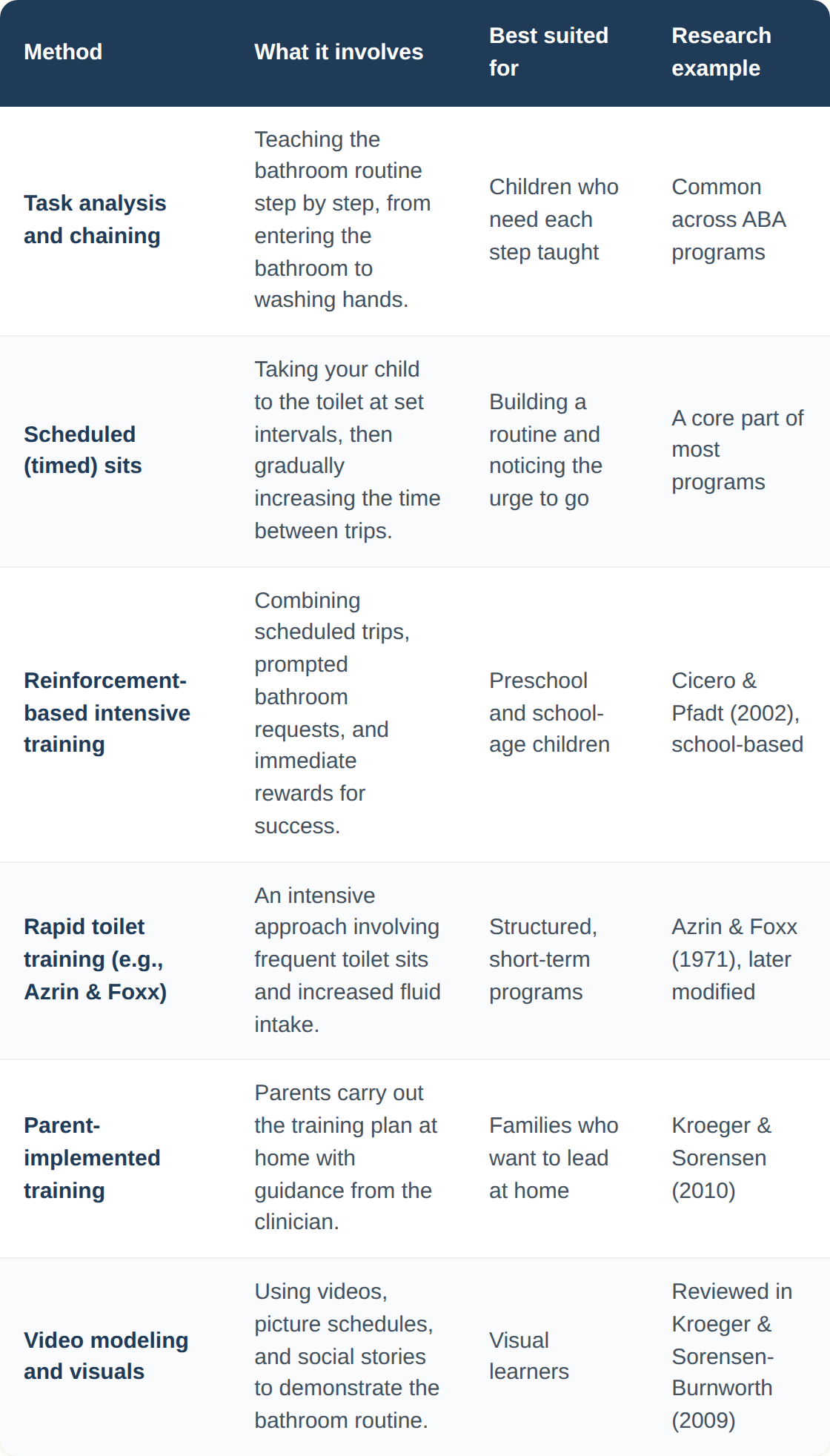
ABA potty training isn’t one specific technique. People often combine different methods, depending on your child’s age, abilities, and challenges.
What is Azrin and Foxx toilet training?
In 1971, researchers Nathan Azrin and Richard Foxx developed an intensive approach called rapid toilet training, built on frequent bathroom trips, repeated practice, and rewards for success. The original method also included corrective procedures after accidents. Modern adaptations of rapid toilet training for autism retain strategies such as scheduled sits and immediate reinforcement while avoiding punitive procedures.
A Step-by-Step ABA Potty Training Plan for Home
Your child’s BCBA will help you develop a plan based on their needs. Still, most home-based toilet training follows a similar path: make the bathroom comfortable and establish a routine, then work on regular toilet sits, communication, and gradually building independence.
- 1. Make the bathroom comfortable. Address anything that might make your child reluctant to sit. A seat insert can feel more secure, a footstool can support their feet, and a quieter bathroom can help if noise bothers them.
- 2. Create a visual schedule. Use pictures to show each part of a bathroom trip, from walking in and sitting down to wiping, flushing, and washing hands.
- 3. Switch to underwear during the day. Underwear lets your child notice when they’re wet, which helps them connect the feeling of needing to go with using the toilet.
- 4. Start timed sits. Take your child to the bathroom at regular intervals instead of waiting for them to ask. Keep each sit short and calm, even if nothing happens.
- 5. Reward success right away. When your child uses the toilet, praise them or offer a small reward they care about right away. Quick timing helps them link the two.
- 6. Teach a way to ask. Help your child learn to tell you they need the bathroom, using words, signs, a picture card, or a communication device. Practice the request during scheduled trips.
- 7. Fade prompts and lengthen intervals. As your child succeeds, gradually reduce your help and space out scheduled trips.
- 8. Practice in other bathrooms. Once your child is comfortable at home, practice in other familiar places, like school or a relative’s house, and eventually public bathrooms.
Potty Training a Nonverbal Autistic Child
Children who don’t communicate verbally can still learn to use the toilet. The key is giving them a reliable way to let someone know when they need to go, such as a picture card, a sign for “potty,” or a button on an AAC (augmentative and alternative communication) device.
Practice the request before each scheduled bathroom trip. For example, if your child uses a picture card, prompt them to hand it to you before heading to the toilet. Over time, they’ll learn to ask without a prompt. These ABA communication skills can also help them express other everyday needs more independently.
Accidents, Setbacks, and Autism Potty Training Regression
Accidents are part of learning, even after steady progress. When one happens, don’t make a big deal of it. Help your child clean up and change without scolding or showing frustration, then move on.
A child who has been using the toilet successfully can also start having accidents again. This kind of autism potty training regression can happen for several reasons, including illness, starting school, changes in routine, or the arrival of a new sibling. If it happens, you may need to return to more frequent scheduled sits and offer extra reinforcement while your child gets back into the routine.
If your child gets very upset during training, understanding the difference between meltdowns and tantrums can help you respond. And if you notice withholding or signs of constipation, talk to your pediatrician first.
When to Get Professional Support
Some children make progress with a consistent home routine, while others need more individualized help. Consider speaking with a BCBA if:
- Your child is frightened of the bathroom or resists sitting on the toilet.
- They’re holding in urine or stool.
- You’ve been practicing consistently for several weeks without seeing progress.
- Toilet training is becoming a significant source of stress for your child or family.
A BCBA can pinpoint what’s getting in the way and build a plan around it.
How United Care ABA Supports Toilet Training
At United Care ABA, our BCBAs build individualized toilet training plans around each child’s skills, communication, and sensory needs. With in-home ABA therapy, your child practices in their own bathroom, where the routine actually needs to work.
We also work closely with parents. Through ABA parent training, you’ll learn the same strategies our therapists use, so practice continues between sessions.
Whether your child is in early intervention ABA or ABA therapy for preschoolers, we can build toilet training into their treatment plan alongside other everyday skills. It’s one of many autism-related life skills we can work on together.
FAQs
How long does ABA potty training take?
There’s no set timeline. In one parent-led study, two autistic children learned to use the toilet at home within 5 to 10 days. Another school-based study reported success within 7 to 11 days for three children. However, some children need several months of consistent practice.
What age should an autistic child be potty trained?
There’s no specific age when an autistic child should be potty trained. Some children are ready during their toddler years, while others need more time. Look for signs of readiness, such as staying dry longer, and consider whether your child has the skills needed to begin.
Can a nonverbal autistic child be potty trained?
Yes. Speaking isn’t required to learn to use the toilet. Children who don’t communicate verbally can use picture cards, signs, or AAC devices to indicate when they need the bathroom. Your BCBA can help you teach this communication method alongside the toilet-training routine.
Should we use pull-ups or underwear?
Many ABA programs recommend switching to underwear during daytime training. Unlike pull-ups, underwear allows children to feel when they’re wet, which may help them recognize the connection between their body’s signals and using the toilet. Nighttime training is different, so discuss that separately with your BCBA.
What is the Azrin and Foxx method?
The Azrin and Foxx method is an intensive toilet training approach developed in 1971. It uses frequent bathroom trips, repeated practice, and rewards for successful toilet use. Modern ABA programs have adapted elements of this method, particularly scheduled sits and reinforcement, without using the punitive procedures included in the original approach.
What if my child was trained and then regressed?
Regression is common, especially after illness or a change in routine. Think about what might have changed, such as a new school or disruptions at home. Returning to more frequent scheduled sits and reinforcing successful toilet use may help. If accidents continue, speak with your pediatrician to rule out medical issues such as constipation.
4 References
-
Azrin, N. H., & Foxx, R. M. (1971). A RAPID METHOD OF TOILET TRAINING THE INSTITUTIONALIZED RETARDED 1. Journal of Applied Behavior Analysis, 4(2), 89-99. https://doi.org/10.1901/jaba.1971.4-89
-
Cicero, F. R., & Pfadt, A. (2002). Investigation of a reinforcement-based toilet training procedure for children with autism. Research in Developmental Disabilities, 23(5), 319-331. https://doi.org/10.1016/S0891-4222(02)00136-1
-
Kroeger, K., & Sorensen, R. (2010). A parent training model for toilet training children with autism. Journal of Intellectual Disability Research, 54(6), 556-567. https://doi.org/10.1111/j.1365-2788.2010.01286.x
-
Kroeger, K., & Sorensen-Burnworth, R. (2009). Toilet training individuals with autism and other developmental disabilities: A critical review. Research in Autism Spectrum Disorders, 3(3), 607-618. https://doi.org/10.1016/j.rasd.2009.01.005